The guitar is a Musical Instrument with ancient roots that is used in a wide variety of musical styles. It typically has six strings but four, seven,eight,ten,eleven,twelve,thirteen and eighteen string guitars also exist.
Guitars are recognized as one of the primary instruments in Jazz,Blue,Country,Flamenco,Mariachi,Rock Music and many forms of pop. Guitars may be played acoustically, where the tone is produced by vibration of the strings and modulated by the hollow body, or they may rely on an amplifier, that can electronically manipulate tone.
Traditionally guitars have usually been constructed by combination of various woods and strung with animal gut, or more recently, with either nylon or steel strings. There are many brands of guitars, but some commonly known brands are PRS, Gibson, Dean, Gretsch, Ibanez, Martin, Jackson, Schecter, and Fender.
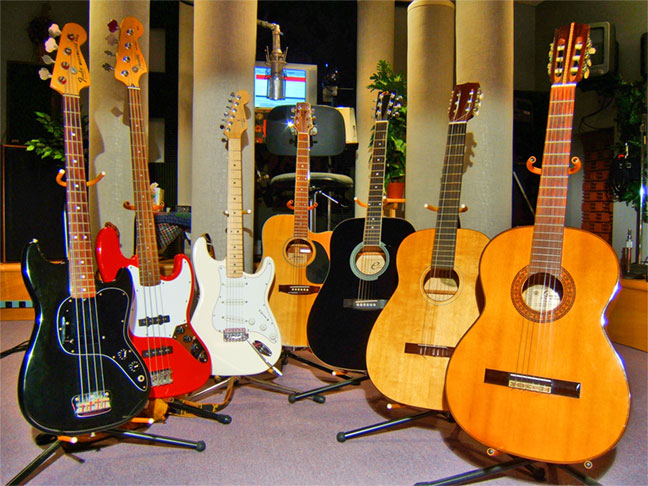
[1] History Of Guitars
Before the development of the electric guitar and the use of synthetic materials, a guitar was defined as being an instrument having "a long, fretted neck, flat wooden soundboard, ribs, and a flat back, most often with incurved sides". Instruments similar to the guitar have been popular for at least 4,000 years. The roots of the guitar can be traced back thousands of years to an Indo-European origin in instruments, For this reason the guitar itself is distantly related to instruments such as the Tanbur and Sitar. The modern word, guitar, was adopted from Spanish guitarra (German Gitarre, French Guitare).
[2] Types Of Guitars
Guitars can be classified into two types
(1) Acoustic (2) Electric
[1] Acoustic Guitars

An acoustic guitar is one not dependent on an external device to be heard but uses a soundboard which is a wooden piece mounted on the front of the guitar's body. The acoustic guitar is quieter than other instruments commonly found in bands and orchestras so when playing within such groups it is often externally amplified. Many acoustic guitars available today feature a variety of pickups which enable the player to amplify and modify the raw guitar sound.
Types Of Acoustic Guitars
1 . Renaissance and Baroque Guitars
2. Classical Guitars
3. The Modern Ten-string Guitar
 Electric guitars can have solid, semi-hollow, or hollow bodies, and produce little sound without amplification. Electromagnetic pickups convert the vibration of the steel strings into electrical signals, which are fed to an amplifier through a cable or radio transmitter. The sound is frequently modified by other electronic devices or the natural distortion of valves (vacuum tubes) in the amplifier.
Guitar Components
1) Headstock : The headstock is located at the end of the guitar neck furthest from the body. It is fitted with machine heads that adjust the tension of the strings, which in turn affects the pitch.
2) Nut : The nut is a small strip of bone,plastic,brass,corain,graphite,stainless steel or other medium-hard material, at the joint where the headstock meets the fretboard.
3) Fretboard : Also called the fingerboard, the fretboards a piece of wood embedded with metal frets that comprises the top of the neck. It is flat on classical guitars and slightly curved crosswise on acoustic and electric guitars.
4) Frets : Frets are metal strips (usually nickel alloy or stainless steel) embedded along the fretboard and located at exact points that divide the scale length.Pressing a string against a fret determines the strings' vibrating length and therefore its resultant pitch. Standard classical guitars have 19 frets and electric guitars between 21 to 24 frets (though Ibanez has issued guitars with as many as 36 frets.)
5) Truss rod: The truss rod is a metal rod that runs along the inside of the neck. It is used to correct changes to the neck's curvature caused by the neck timbers aging, changes in humidity or to compensate for changes in the tension of strings.
6) Inlays : Inlays are visual elements set into the exterior surface of a guitar. The typical locations for inlay are on the fretboard, headstock, and on acoustic guitars around the sound hole, known as the rosette. Inlays range from simple plastic dots on the fretboard to intricate works of art covering the entire exterior surface of a guitar (front and back).
7) Neck : A guitar's frets, fretboard, tuners, headstock, and truss rod, all attached to a long wooden extension, collectively constitute its neck. The wood used to make the fretboard will usually differ from the wood in the rest of the neck. The bending stress on the neck is considerable, particularly when heavier gauge strings are used , and the ability of the neck to resist bending is important to the guitar's ability to hold a constant pitch during tuning or when strings are fretted. The rigidity of the neck with respect to the body of the guitar is one determinant of a good instrument versus a poor one. The shape of the neck can also vary, from a gentle "C" curve to a more pronounced "V" curve.
8) Neck joint or 'Heel' : This is the point at which the neck is either bolted or glued to the body of the guitar. Almost all acoustic guitars, with the primary exception of Taylors, have glued (otherwise known as set) necks, while electric guitars are constructed using both types.
9) Strings : Modern guitar strings are constructed of metal, polymers, or animal or plant product materials. Instruments utilizing "steel" strings may have strings made of alloys incorporating steel, nickel or phosphor bronze. Classical and flamenco instruments historically used gut strings, but these have been superseded by polymer materials, such as nylon and fluorocarbon materials. Bass strings for both instruments are wound rather than mono filament.
10) Pickguard : Also known as a scratch plate. This is usually a piece of laminated plastic or other material that protects the finish of the top of the guitar from damage due to the use of a plectrum or fingernails. Electric guitars sometimes mount pickups and electronics on the pickguard. It is a common feature on steel-string acoustic guitars. Vigorous performance styles such as flamenco, which can involve the use of the guitar as a percussion instrument, call for a scratch plate to be fitted to nylon-string instruments.
11) Tremolo arm : Many electric guitars are fitted with a vibrato and pitch bend device known as a "tremolo bar (or arm)", "sissy bar", "wang bar", "slam handle", "whammy handle", and "whammy bar". The latter two terms led stompbox manufacturers to use the term 'whammy' in coming up with a pitch raising effect introduced by popular guitar effects pedal brand "Digitech".
12) Guitar Strap : Strip of fabric with a leather or synthetic piece on each end. Made to hold a guitar via the shoulders, at an adjustable length to suit the position favored by the guitarist
Tuning :
The table below shows pitch names found over the six strings of a guitar in standard tuning, from the nut (zero), to the twelfth fret.

Source : Google & Wikipedia


.jpg)